
 English
 Русский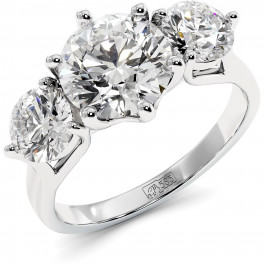
Moissanite is a monocrystal of silicon carbide, the chemical formula is SiC. Moissanite was first found by French chemist Henri Moissan in a meteor crater in Arizona in 1893. At the beginning, this crystal was mistaken for a diamond because of very similar properties, but as a result of extensive research it was concluded that it is an independent mineral, which was named after the discoverer.
What is interesting about moissanite? First of all, its properties are very close to those of diamond.

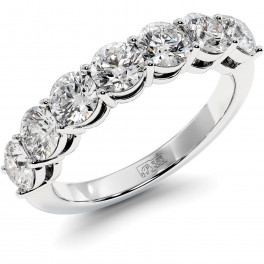
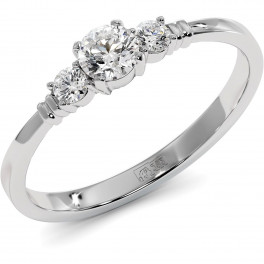
Moissanite ring
Hardness. In terms of hardness, moissanite ranks second after diamond with a value on the Mohs scale of 9.5. This value is higher than that of sapphire or ruby. Therefore, it is impossible to scratch it with anything other than a diamond.
Refractive index. It is the high refractive index of 2.42 that gives the diamond its unique appearance. When properly cut, a diamond is able to refract and return back all the light that has entered it from above. This is the reason for its "brightness", "depth" and "brilliance" (alternation of the facet pattern). As a comparison, you can look at cubic zirconia, which with a refractive index of 2.18 already at a small viewing angle to the site looks like glass, letting light through. Moissanite even surpasses a diamond with a value of 2.65 in this indicator.
Dispersion. This indicator means the ability of the material to decompose the white light passing through it into spectral components. It is thanks to the high dispersion of 0.044 that the diamond plays with all the colors of the rainbow, which favorably distinguishes it from leucosapphire and other colorless stones. The dispersion of moissanite is 0.104, which allows the moissanite to play even more strongly with color flashes.
Temperature resistance. As you know, a diamond can withstand temperatures up to 800 degrees Celsius, after which it begins to char and evaporate. Moissanite, on the other hand, can withstand temperatures over 2000 degrees, which allows you to repair products with moissanite without strengthening the stone.

Largest natural moissanite 4.1mm long, found in Kishon river, Israel. Photo by Vered Toledo.
Since natural moissanite is found only in the form of the smallest particles, the largest of which resembles a stick 4.1 mm long, all moissanite used in jewelry is artificially grown. For the first time, the American company Charles & Colvard came up with the idea of using moissanite in jewelry. With a specially designed cut, moissanites surpass even the perfect diamond in fire and brilliance!
Not all moissanites are the same! Most cheap moissanites have a specific crystal lattice structure called the 6H-SiC polytype. they are the easiest to manufacture. Such stones exhibit strong yellow fluorescence in daylight, as a result of which the stone looks yellowish and cloudy. The moissanites used in BS Jewelry products have the 4H-SiC polytype, so they are free from yellow fluorescence and remain luxuriously white in all conditions.
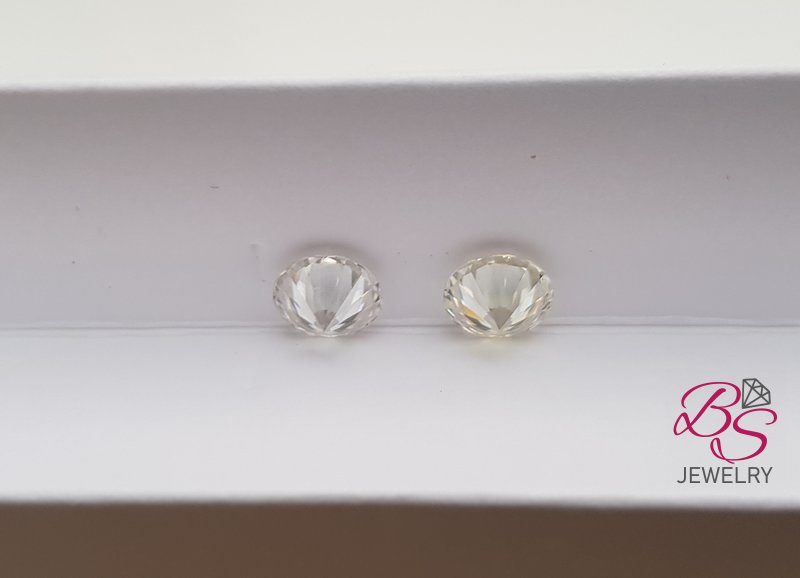
BS Moissanite (left) vs cheap moissanite (right) under daylight (last shows yellow fluorescence).
In addition, the special H&A cut of our BS moissanite makes it indistinguishable from a perfect diamond in terms of appearance, fire and brilliance.
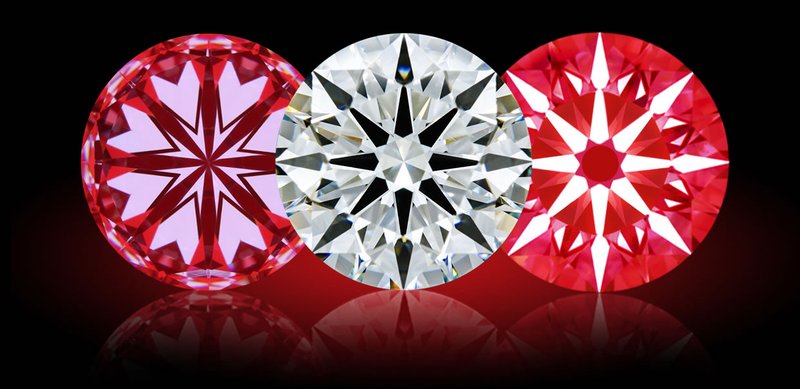
Hearts and Arrows cut guarantees 100% ideal diamond look.
BS moissanites come with lifetime warranty on their optical properties. It guarantees that the gemstone maintain its color, fire and brilliance forever.
So the advantages of BS Moissanite:
- - Perfect H&A Cut
- - No fluorescence
- - Near ideal color and clarity up to E / VVS1 for BS Premium
- - Lifetime warranty
Welcome to the BS Jewelry catalog and choose high-quality golden moissanite jewelry in the most current designs!